Document Actions
David Hughes
Study systems include
ants and other social insects
parasites of ants (notably zombie ants)
fungi
agriculture and ant mediated disease spread (Cassava)
epidemic history and religious belief
Selected publications
Hughes, D.P., Andersen, S.* Hywel-Jones, N.L. , Himaman, W., Bilen, J., & Boomsma, J.J. (2011). Behavioral mechanisms and morphological symptoms of zombie ants dying from fungal infection BMC Ecology 11:13doi:10.1186/1472-6785-11-1 (Link) (PDF)
Hughes, D.P., Wappler, T., & Labandeira, C.C. (2010). Ancient death-grip leaf scars reveal ant fungal parasitism Biology Letters 18th August doi:10.1098/rsbl.2010.0521 (PDF)
Hughes, D.P. (2011). Recent developments in sociobiology and the scientific method Trends in Ecology and Evolution 26(2) 57-8 (PDF)
Hughes, D.P., N.E. Pierce, & Boomsma, J.J. (2008). Social insect symbionts: evolution in homeostatic fortresses. Trends in Ecology and Evolution 23(12): 672-677 (PDF)
Evans, H.E., Elliot, S.L., & Hughes, D.P. (2011). Hidden diversity behind the Zombie-Ant fungus Ophiocordyceps unilateralis: Four new species described from Carpenter ants in Minas Gerais, Brazil PloS One 6(3): e17024
Books
P. D'Ettorre & D.P. Hughes (2008) Sociobiology of Communication. OUP
Hughes, D.P., Bordeur, J, & Thomas, F. Host Manipulation by Parasites. OUP
Assistant Professor of Entomology and Biology
Email: dhughes@psu.edu
Phone: 814-863-6073
Office: 129 Millennium Science Complex
Research interests
I am interested in the role of behavior in disease transmission. At one extreme we have parasites that have evolved strategies to control host behavior and at the other there is the ability on the part of hosts to completely avoid infection through behavioral defense. To approach the former I use ants and other insects that are manipulated by diverse parasites. Most of my recent work has been on fungi that control ant behavior. To approach the latter example (of behavioral defense) I have recently become very interested in human behavior and in particular the expression of altruistic care by certain individuals during epidemics. I am working on the thesis that belief systems shape the expression of this behavior.
I am very interested in biodiversity and life histories and how extreme our lack of knowledge is in this regard. A lot of my work is in tropical rain forests on understudied taxa which drives home the apparent ignorance we have. Such simple things as the behavior of infected individuals and vectors; or the diversity of parasites in apparently well known groups remain unknown. I am also very much interested in the concept of the extended phenotypes. Finally, I like architecture and how the cultural evolution of cities shapes the evolution of diseases.
Extended Phenotype of parasites
In his seminal book, published 30 years ago, Richard Dawkins established the theory of the Extended Phenotype. Its central thesis is that genes can have effects far beyond the organisms in which they reside. Rather than genes acting only on the surface of organism in which they reside (i.e. the classic phenotype) they could have an extended phenotypic effect beyond the organism itself. In advocacy of his alternative view, Dawkins marshalled us through examples of Animal Constructions to the Manipulation of Host Behaviour by parasites and finally to the logical conclusion of Action at a Distance where genes in one organism change the phenotype of another without any physical contact (a flower gene influencing a pollinator’s behaviour and flight).
Parasites manipulating host behavior is the EP most widely studied and a number of different systems are progressing well towards and understanding of the mechanisms by which control is achieved, the ecoogical significance of manipulated hosts and of course the adaptive interpretation of control. You can see a video of the zombie ant work here. For me a major future component will understandng the paleobiology of EP through phylogentic reconstruction, fossil evidence and time tree analysis of manipulation.
Biodiversity of parasites in ants
As much as half of life on earth are parasites. I am particularly interested in the biodiversity of those inside ant nests. Ants have at least 111 arthropod families from 17 orders which does not include micro-parasites such as fungi, protists, bacteria or virus. The approach is take is biodiversity survey work complemented by excellent collaborations with alpha-taxonomists to describe new species. We are focusing on this first by examining fungi in ants (the work is collaborative with Harry Evans, Tatiana Sanjuan, Joey Spatafora and Roger Shivas). Harry and I have assembled a database covering 16 countries and 39 years and we have sampled together in Australia. Ghana and Brazil. Recently (Jan 2012) we had a large survey in the Brazilian Amazon.
Our work integrates taxonomy, systematics, comparative genomics and trait based classifications which for parasites included the modes and mechanisms of infection.
Disease transmission in ant societies
Colonies of social insects are interesting because they present two hosts for parasites: the individual that is infected and the colony to which that individual belongs. What this implies is that maximum virulence (host death) might paradoxically translate to zero (or near zero) virulence for the colony if loss the infected worker does not affect colony fitness due to the redundant nature of societies. Paradoxically because of indirect fitness benefits worker death might not have any effects on the the fitness of the dead worker! The other interesting aspect is how disease transmits from colony to colony. We are exploring this using 3D mapping of disease spread in Brazilian tropical forests.
Agriculture and plant diseases vectored by ants
Ants pose a significant threat to agriculture when they occur in a mutualism with phloem feeding insects such as hemipterans. Much of the disease incidence and spread of diseases on plants is due to the hundreds of thousands of ants that protect plant-feeding insects that vector disease. Ants farm these sucking insects and ‘milk’ them for the by-product sugar they excrete. This is a strong mutualism and ant protection increases the populations of plant feeding insects, and in turn, this greatly increases the rate of disease spread between plants as the bugs transmit viral and bacterial infections and the hundreds of thousands of ant legs and mandibles introduce fungi and psuedo-fungi (oomycetes) into leaf tissue. Reflecting the successful integration found in CIDD I am interested in bringing diverse approaches to study agricultural diseases. We are working now on ants ins small holder farms of Cassva and Cocoa in Ghana. You see further details on my views on plant pathology in my recent lecture.
Human disease and altruism
It is common for students of ants to think of human societies. I have recently become interested in one aspect of disease in human societies which are epidemic crowd disease that result from the development of cities over the last five millennia. What particularly intrigues me is why do some people during epidemics deliberately expose themselves to contagion by helping others. I am working with a religious scholar (Philip Jenkins) and sociologist (Jenny Trinitopili) at PSU to explore this.
Group Members
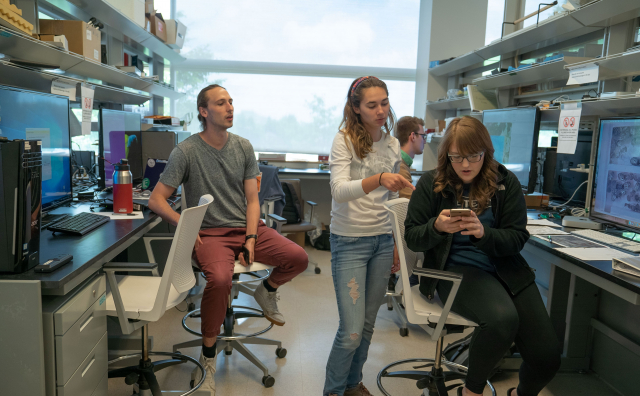
Post-doctoral researchers
Charissa de Bekker, Marie Curie Fellow (post-doc, more details here )
Anna Schmidt, Carlsberg Foundation Fellow (post-doc, more details here)
Rob Anderson, post-doc (more details here)
PhD Students
Raquel Loreto,
Undergraduate students